
The gap between those two scenarios catches a lot of businesses out. Basic cloud VoIP can go live in 24–48 hours, while multi-user setups with porting and training typically take 1–2 weeks. Skip bandwidth testing or line-by-line validation, and the result is dropped calls, misrouted clients and costly rework.
The good news is that a clean installation follows a predictable process. Once you know the phases, most problems can be avoided before go-live.
In this blog, you will learn why proper installation matters in 2026, the main types of business phone systems, how cloud VoIP, hosted PBX and on-premise PBX compare, the four installation phases, the steps to install a business phone system, common problems and fixes, and how to choose the right installer.
Key Takeaways
- Plan before you plug in: A needs analysis, network test and extension worksheet prevent most post-launch problems.
- Voice quality is a network problem: Bandwidth, jitter and Quality of Service (QoS) settings decide whether calls sound clear.
- Porting needs its own timeline: Keep the old service running until every number has transferred and been tested.
- Test every line before go-live: Inbound, outbound, voicemail, after-hours routing and every ring group should be checked.
- Phones belong with your IT: One partner managing phones, network and security avoids finger-pointing between vendors.
- Training finishes the job: Staff who know how to transfer, park and forward calls get far more from the new system.
Why Does Proper Phone System Installation Matter in 2026?
Most businesses have moved from copper lines to internet-based calling. That makes the phone system part of your network, with the same dependencies on bandwidth, switches and security.
A careless install shows up quickly in missed calls and frustrated clients.
Getting the installation right matters for several practical reasons:
1. Missed Calls Cost Business
Misrouted calls, broken auto attendants and silent voicemail boxes send clients elsewhere, often before anyone internally notices.
2. Voice Runs on Your Network
Calls compete with file uploads and video meetings. Without enough bandwidth and QoS, voice quality suffers first.
3. Hybrid Teams Need Flexible Phones
Staff expect to take work calls on a desk phone, a laptop or a mobile app, with the same number and features everywhere.
4. Emergency Details Must Be Right
Each phone and user needs accurate emergency (E911) location information, which is easy to overlook during a rushed setup.
Understanding why installation matters makes it easier to choose the right type of system.
4 Types of Business Phone Systems to Install
Business phone systems now come in several forms. The right choice depends on your size, locations and how much hardware you want to own.
Here are the main options:
1. Cloud VoIP and UCaaS
The provider hosts the phone system, and calls, messaging and video run over the internet. Ideal for small and growing businesses that want fast setup. Learn more about VoIP phone systems for small businesses.
2. Hosted PBX
A PBX runs in a provider's data center and delivers traditional features such as extensions, ring groups and auto attendants. Ideal for offices that want familiar phone features without on-site hardware.
3. On-Premise IP-PBX
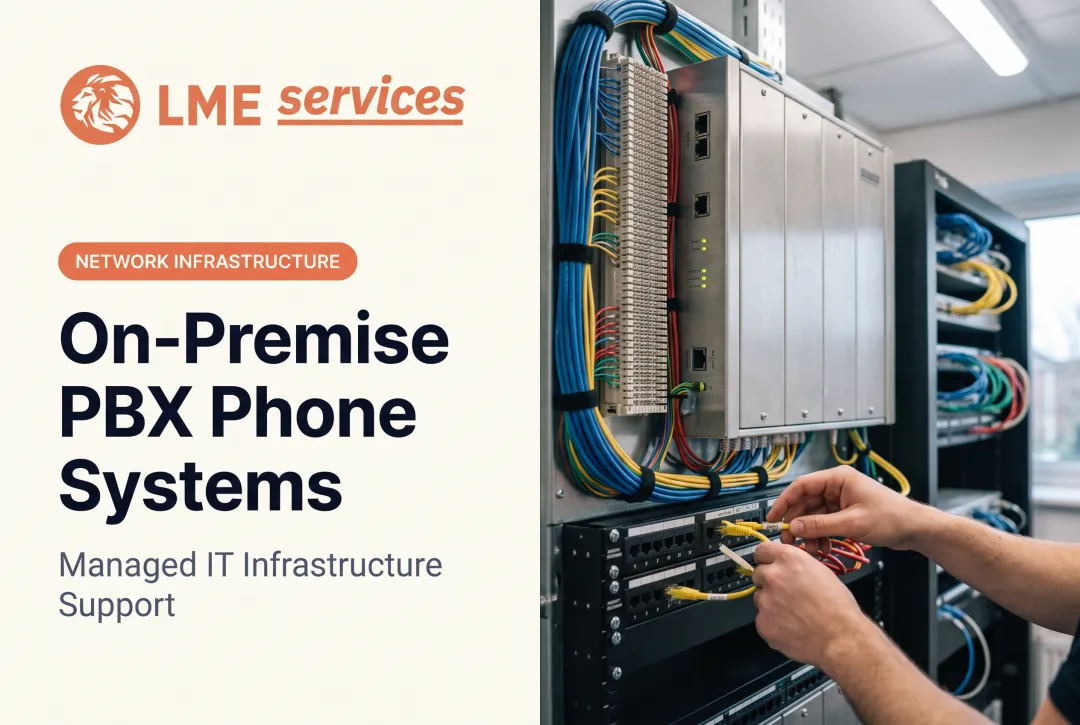
The call-switching hardware sits in your building and connects to the outside world through SIP trunks. Ideal for businesses with existing cabling, strict control needs or in-house IT.
4. Softphone-Only Setups
Users make and receive calls through desktop or mobile apps with a headset. Ideal for remote-first teams, though most offices keep a desk phone or two at reception.
Once you know the options, it helps to see how the main approaches compare.
Also Read: On-Premise PBX Phone Systems
Cloud VoIP vs Hosted PBX vs On-Premise PBX: What's the Difference?
All three can deliver reliable business calling. The differences show up in setup time, upfront hardware and who maintains the system.
Here's how they stack up on the factors that matter most:
| Aspect | Cloud VoIP / UCaaS | Hosted PBX | On-Premise IP-PBX |
|---|---|---|---|
| Typical setup time | Days for simple setups | Days to weeks | Weeks, depending on hardware |
| Upfront hardware | Phones or headsets only | Phones or headsets only | PBX server, phones and gateways |
| Who maintains it | The provider | The provider | You or your IT partner |
| Adding users | Almost instant | Quick | May need new hardware or licenses |
| Internet outage | Calls forward to mobiles if configured | Calls forward if configured | Internal calls may keep working |
| Remote work | Built in | Usually supported | Needs extra setup |
| Best for | Small and growing teams | Offices wanting classic PBX features | Larger sites with existing investment |
To be fair, on-premise systems still win on direct control and can make sense where cabling and hardware are already paid for. For most small and mid-size businesses, though, cloud VoIP offers the simplest installation.
With the system type chosen, the next step is understanding how the installation itself unfolds.
The 4 Phases of Business Phone System Installation
Every installation, large or small, moves through the same four phases.
| Phase | What Happens | Who's Involved |
|---|---|---|
| 1. Needs analysis and preparation | Users, locations, features and pain points are documented, and the network is tested | Owner, office manager, IT |
| 2. Number and hardware setup | Extensions are provisioned, numbers are submitted for porting, and phones are ordered | IT and the phone provider |
| 3. Configuration and integration | Call flows, auto attendants, voicemail and CRM connections are built | IT, provider and the person who runs call flow |
| 4. Testing and validation | Every line, ring group and routing rule is tested before go-live | IT and front-desk staff |

Before hardware goes live, confirm the fundamentals. RingCentral recommends 90 kbps or higher for each voice line, so multiply by your expected simultaneous calls and leave headroom for data. Check that your switches supply Power over Ethernet (PoE) to desk phones, since most IP phones need the 802.3af or 802.3at standard.
Documentation matters as much as hardware. A telephone station worksheet should capture, for each user, the extension, directory name, device type, voicemail email, physical and E911 location, and routing destination.

With the phases and prerequisites clear, here's how the work breaks down step by step.
7 Simple Steps to Install a Business Phone System
Skipping the needs analysis or worksheet is the single biggest cause of post-launch rework. Following the steps in order keeps the installation process predictable.
Follow these steps to get it done:
Step 1: Run a Needs Analysis
Document user count, locations, required features such as call recording, auto attendant and CRM integration, and the problems with your current system.
Step 2: Test the Network
Measure bandwidth, latency and jitter, and upgrade internet service or switches if the network can't carry the expected call volume.
Step 3: Choose a Provider and Review the Quote
Ask for an itemized breakdown of hardware, licensing, installation labor and ongoing support, so nothing surprises you later.
Step 4: Complete the Station Worksheet
Map every extension, directory name, voicemail email, E911 location and routing destination before configuration starts.
Step 5: Configure Call Flows
Set up day and night routing, auto attendant menus, holiday schedules, ring groups and calling permissions.
Step 6: Port Numbers and Install Hardware
Simple ports can complete in one business day under FCC rules, but multi-line business ports often take longer. Submit early, and keep the old service active until the new one is confirmed.

Step 7: Test, Validate and Train
Test inbound and outbound calls on every extension, confirm the auto attendant and voicemail-to-email work, check after-hours routing, and train staff on everyday features.

Also Read: Network Assessment Guide
Even careful installations hit a few common snags, so it helps to know the fixes in advance.
Common Phone Installation Problems and Fixes
Most post-launch issues trace back to the network, the worksheet or the porting paperwork.
| Problem | Likely Cause | Fix |
|---|---|---|
| Choppy or dropped calls | Low bandwidth, congestion or no QoS; RingCentral notes jitter above 50 ms degrades voice quality | Add bandwidth, prioritize voice with QoS settings, and separate voice traffic |
| Calls ringing the wrong person | Errors or gaps in the station worksheet | Review routing with the office manager who runs daily call flow |
| Failed or delayed number ports | Mismatched account number, billing ZIP or business name | Get timelines in writing and run parallel service until confirmed |
| Voicemail not reaching email | Wrong addresses or spam filtering | Verify addresses and allow the provider's mail servers |
| Desk phones not powering on | Switches without PoE or the wrong PoE standard | Upgrade switches or add PoE injectors |
Scheduling cutover during low call-volume periods, such as evenings or weekends, keeps any remaining issues away from clients. Phone projects tied to network upgrades also go more smoothly when one partner owns both.
Knowing the common problems makes it easier to judge who should handle your installation.
How to Choose the Right Business Phone System Installer?
The right installer depends on your size, locations and how closely phones tie into the rest of your IT. These are the factors that matter most:
- Network expertise: The installer should test and, if needed, fix your network before phones go live.
- Migration experience: Ask how they handle porting, legacy hardware and cutover without downtime.
- Support for every device: Desk phones, softphones and mobile apps should all be configured and supported.
- User training included: Staff should learn transfers, forwarding and voicemail as part of the project.
- Ongoing monitoring and support: Look for monitoring and 24/7 support after go-live, not just an install and goodbye.
- One partner for phones and IT: Combining managed IT support and phones avoids gaps between vendors.
- A clear, itemized quote: Every hardware, licensing and labor line should be explained upfront.
Thinking through these factors helps you choose an installer who keeps your phones reliable long after go-live.
Also Read: Securing Network Infrastructure
How LME Services Helps Businesses Install Phone Systems That Just Work
Many businesses put off replacing an aging phone system because the last change was painful. Others juggle a phone vendor, an internet provider and an IT company, and nobody owns the whole picture when calls start dropping.
LME Services is a family-run, second-generation managed IT and cybersecurity provider headquartered in Hoffman Estates, Illinois, delivering modern business phone systems, installed and managed for Chicagoland businesses. Leon Engelking founded LME in 1994 after leaving IBM, and his son, CEO Joe Engelking, leads the company today. As Joe puts it, "I've used my experience across small and large IT companies to craft an IT experience that blends the stability of large IT with the personal service of SMB IT."
Phone system services at LME include:
- Business Phone Systems and Installation Services
- VoIP Phone Service for Small Business
- VoIP Phone Systems for Small Businesses
- VoIP and Unified Communications
- IT Installation Services for Business
- Services for Network Integration
Here's what sets LME apart:
- Installation and migrations handled for you: LME installs new systems and migrates or upgrades existing phone systems with minimal disruption.
- Soft phones and desk phones: Staff can work from desk phones in the office or soft phones on laptops and mobile devices.
- Network readiness built in: Every phone plan includes network and infrastructure management plus systems monitoring, so voice quality is protected at the source.
- Proven in real projects: For Northwest Contractors, LME delivered 3CX VoIP alongside new Wi-Fi, a new firewall and a backup internet line as part of a full IT modernization.
- Training and 24/7 support: User training is part of the rollout, and 24/7 support covers business-stopping problems after go-live.
- A trusted local team: One Google reviewer, George, writes: "Their availability, knowledge and integrity is not something you see every day."
- Clear, low-risk terms: An experienced technician runs the discovery call, a tailored quote follows, and plans run on a 1-year agreement with a 30-day opt-out.
This approach helps businesses move from dreading a phone change to a rollout that simply works on day one.
Conclusion
Business phone system installation ranges from a one-hour app setup to a multi-week project with porting, cabling and custom routing. What shapes your results is planning, a network ready for voice, accurate worksheets and testing every line before go-live.
Who you work with has a direct effect on those results. Network expertise, careful migrations and ongoing support often decide whether a new system improves client calls or creates new headaches.
If you're planning a new phone system or replacing an old one, connect with the LME Services team today for a free 15-minute consultation, and find out how to get a clean installation with minimal disruption.
Frequently Asked Questions
How long does business phone system installation take?
According to Phone.com, basic cloud setups can go live in 24–48 hours, while multi-user deployments with number porting and training typically take 1–2 weeks. Multi-location rollouts can take longer.
How much does it cost to install a business phone system?
Cost depends on the number of users and phones, the hardware you need, required features and the installation scope. Ask for an itemized quote that separates hardware, licensing, labor and ongoing support.
Do I need to change my phone number when switching providers?
No. Number porting lets you keep your existing numbers. Keep the old service active until every ported number has been tested.
Can I install a business phone system myself?
Basic softphone or cloud apps can often be self-installed. Multi-line offices, structured cabling and compliance-sensitive businesses usually benefit from professional installation.
What internet speed do I need for a VoIP phone system?
RingCentral recommends at least 90 kbps per concurrent call, so multiply that by your expected simultaneous calls and leave headroom for data. Prioritize voice traffic with QoS, especially in busy offices.